Blocked Drains in Peruíbe SP: What to Do When the Usual Method Fails
In 2026, Peruíbe’s older drainage networks and the heavy summer flow from the Serra do Mar have made one thing clear: the plunger-and-hot-water routine that used to work on a slow sink now fails more often than it succeeds. If you are searching for a desentupidora Peruíbe SP, the practical answer is that you need a technician with inspection and jetting equipment, not another bottle of chemical drain cleaner. This is the routine I follow when the household method has already been tried and the line is still backed up.
Why the Usual Fixes Stop Working in Peruíbe
Most call-outs I handle in Peruíbe start the same way: the resident has already plunged, poured a caustic product, and waited. The drain gurgles, drains slowly for an hour, then fills again. That pattern tells me the blockage is not a surface clog but a restriction deeper in the branch line or in the street connection.
Coastal humidity, sandy soil and older clay or cast-iron pipes in the central neighbourhoods make root intrusion and sediment build-up common. Chemical products only dissolve grease and hair; they do nothing to roots, sand or collapsed joints. Worse, repeated caustic use can damage PVC seals and make the eventual repair more expensive.
Problem 1: The plunger clears nothing and water rises in the second fixture
When flushing one fixture makes water appear in another, the blockage sits past the trap and past the branch junction. Stop plunging, because you are pushing wastewater into a shared line. The fix is a mechanical auger or a high-pressure jetting hose run from the nearest access point, followed by a camera check to confirm the line is clear along its full length.
Problem 2: Chemical cleaner leaves a slow drain that keeps returning
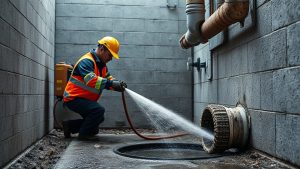
A drain that slows again within days means the product only ate a channel through the clog. The remaining ring of grease and scale catches debris immediately. The fix is hydrojetting, which scours the pipe wall rather than punching a hole through the obstruction. After jetting, a technician should confirm flow with a test flush before closing the access.
Problem 3: The toilet backs up but sinks drain fine
This usually points to a blockage in the toilet branch or in the vertical stack, not the main line. A toilet auger reaches the bend that a plunger cannot, and a camera inspection shows whether the issue is a foreign object, a displaced flange or roots at a joint. Do not keep flushing, because each attempt adds water to a line that has nowhere to send it.
Problem 4: The whole property smells and drains slowly after rain
Rain-driven backflow is a different failure. It suggests the property connection is partially collapsed, root-blocked or undersized for the current runoff. The fix is not a quick snake but a survey of the connection and, where needed, a scheduled desentupidora Peruíbe visit with jetting and a camera record you can keep for the condominium or the landlord.
Problem 5: The septic tank or grease trap is full, not the pipe
Properties on the outskirts of Peruíbe that are not on the public sewer often blame the pipes when the real issue is a saturated tank. Pumping and cleaning the tank restores flow; snaking the line without addressing the tank just moves the problem a few days forward. Ask for a tank level check before authorising any line work.
Problem 6: The access point is missing or buried
Older homes sometimes have no inspection box, or it was paved over during a renovation. A technician should locate the line with a camera and a locator, then open a proper access point. Reopening the line without access is temporary work; adding an inspection box is what prevents the next emergency.
Problem 7: The emergency happens at night or on a weekend
Sewage backing up into a ground-floor bathroom cannot wait for Monday. This is where a 24-hour desentupidora em Peruíbe SP matters: the call is answered, a team is dispatched, and the line is cleared before the damage spreads to flooring and walls. Keep the number saved before you need it.
How a Professional Call-Out Actually Runs
The routine is predictable once you know it, and knowing it helps you judge whether the technician is doing the job properly or just selling a quick snake.
- Interview and isolation. Identify which fixtures are affected, stop water use, and protect the floor.
- Access and inspection. Open the nearest inspection box or remove the trap, then run a camera to locate the obstruction and measure its distance.
- Mechanical clearing. Use a cable auger for roots and solid objects, or hydrojetting for grease, sand and scale.
- Verification. Re-run the camera and flush test water to confirm full-bore flow.
- Report and prevention. Record the pipe condition, note any cracked or displaced sections, and recommend a maintenance interval.
Cost varies with access, pipe length and the method needed. A simple branch clearing sits at the low end; root cutting plus camera survey plus a new inspection box sits at the high end. Ask for the scope before work begins, and ask whether the camera survey is included or billed separately.
| Method | Best for | Limitation |
|---|---|---|
| Plunger | Surface clogs in a trap | Pushes waste into shared lines |
| Chemical cleaner | Light grease and hair | Damages seals, leaves scale behind |
| Cable auger | Roots, solid objects, toilet branches | Does not clean the pipe wall |
| Hydrojetting | Grease, sand, scale, full-length cleaning | Needs a proper access point |
| Camera survey | Diagnosis and verification | Diagnostic only, not a clearing method |
Frequently Asked Questions
Can I keep using the drain after a partial clearing?
Use it sparingly and only with a strainer in place. A partial clearing is a temporary state, and the restriction will return. Book a full jetting and camera check within the same week.
Is chemical drain cleaner ever acceptable?
Only for a light grease clog in a single fixture, and never in a line that is fully blocked. If the water is standing still, the product sits in the pipe and damages it without clearing anything.
How often should a Peruíbe property be checked?
Homes with mature trees near the line or older clay pipes benefit from an annual camera check. Commercial kitchens and condominiums with grease traps usually need quarterly attention.
What should I have ready before the technician arrives?
Clear access to the inspection box, note which fixtures are affected, and mention any recent renovation or chemical use. That information shortens the diagnosis and reduces the bill.